

Bluetooth Trackers and Casing for Dogs: 2026 Guide
Table of Contents
- How Bluetooth Dog Trackers Work in 2026
- Bluetooth vs GPS Pet Tracking: Which Suits Your Dog?
- Durable Dog Tracker Cases: What to Look For in Australian Dog Gear
- Tactical Collar Tracker Mounts: Secure Attachment Methods
- Comparing the RDD Smart Tag Tracker to Basic AirTag Trackers
- Subscription Costs and Battery Longevity
- Frequently Asked Questions
Last Updated: September 24, 2026
How Bluetooth Dog Trackers Work in 2026
Bluetooth trackers and casing for dogs have become the go-to safety setup for owners who want a lightweight, no-subscription way to find a dog that has slipped a gate or bolted after a scent, and they're fast becoming a standard piece of Australian dog gear for outdoor owners. Rather than relying on satellites, these tags lean on the millions of phones already in people's pockets. This guide from Red Dirt Dogs breaks down how the technology works, what a durable case actually protects against, and how to mount a tag so it stays put through mud, scrub and creek crossings.
Here's the part most guides skip: the tracker is only half the system. The casing and the attachment point decide whether it survives a working dog's week.
Crowd-Sourced Networks Explained
A crowd-sourced network is a system where nearby phones act as anonymous detectors, picking up a tracker's Bluetooth signal and relaying its approximate location back to the owner's app. Apple's Find My network and Google's Find My Device network are the two largest examples, and a tag compatible with both gives you the widest possible coverage.
The practical trade-off is density. In suburbs and city streets, there are enough passing phones to update a location within minutes. Out on a remote property, updates can be sparse because there are simply fewer devices nearby to hear the signal. That's not a fault in the tag; it's how the network is built.
Bluetooth vs GPS Pet Tracking: Which Suits Your Dog?
Bluetooth tracking suits dogs that spend most of their time near populated areas, while GPS tracking suits dogs working far from any phone coverage. The right pick comes down to where your dog actually goes, not which spec sheet looks better.
| Feature | Bluetooth tracker | GPS tracker |
|---|---|---|
| Network | Crowd-sourced phone detection | Mobile or satellite signal |
| Subscription | None | Usually ongoing |
| Battery | Replaceable coin cell | Rechargeable, shorter cycles |
| Best for | Suburban and town dogs | Remote working dogs |
| Weak spot | Sparse coverage in the bush | Monthly fees and charging |
For most owners of active pets around town, a Bluetooth tag paired with a proper case covers the realistic escape scenarios. For a dog working stock kilometres from the nearest house, GPS remains the more dependable option.
Durable Dog Tracker Cases: What to Look For in Australian Dog Gear
Durable dog tracker cases need three things: a sealed housing, a rigid shell, and a metal attachment point. Skip any one of those and you're relying on luck.

A soft silicone sleeve feels protective but offers little against a direct knock. A hard shell absorbs impact and keeps the tracker seated. The seal matters just as much, because a tag that fills with water stops transmitting.
IP67 Waterproof Rating and Impact Resistance
An IP67 waterproof rating means the enclosure can handle submersion in up to one metre of water for 30 minutes. That covers rain, puddles, dams and creek crossings comfortably.
Impact resistance is the other half of the job. A rigid TPU shell spreads the force of a knock across the housing instead of the tracker inside it. The IP code ratings explained by the International Electrotechnical Commission set out exactly what each digit means, so you can compare claims honestly rather than trusting a sticker.
Tactical Collar Tracker Mounts: Secure Attachment Methods
Tactical collar tracker mounts work best when the tracker sits flat against the webbing and attaches through a solid metal ring rather than a fabric loop. Flat mounting stops the tag catching on scrub and reduces the use a dog can put on it.
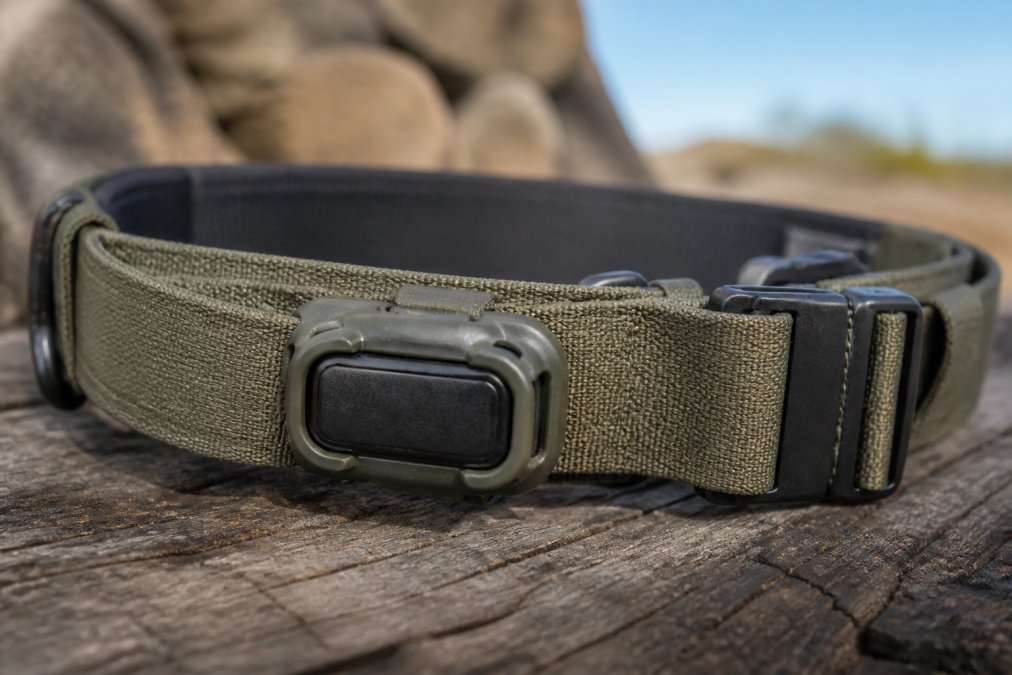
Three mounting approaches cover most situations:
- Metal ring to D-ring: clips onto the same ring you'd use for a leash. Fast, secure and easy to move between collars.
- Sleeve threaded onto the collar: the webbing runs through the case, so there's nothing to snag or unclip.
- Harness-mounted: keeps weight off the neck, which suits slim-necked sighthound breeds. Not sure on sizing? See our guide on how to measure your dog for a harness before you mount a tracker on one.
Comparing the RDD Smart Tag Tracker to Basic AirTag Trackers
The RDD Smart Tag Tracker is the stronger pick for dog owners because it works across both Apple Find My and Google Find My Device, includes an IP67 case, and carries no subscription. A basic AirTag is a fine general-purpose tag, but it's built for keys and bags, not for a dog that lives outdoors.

RDD Smart Tag Tracker
- Pros: dual-network compatibility, IP67 waterproof case included, no subscription ever, replaceable CR2032 battery, compact 32mm size that suits slim-necked breeds
- Cons: location updates depend on nearby phone density
Basic AirTag trackers
- Pros: widely available, simple setup inside the Apple ecosystem
- Cons: Apple-only, no built-in waterproofing, and the factory attachment options aren't designed for collar use
Subscription Costs and Battery Longevity
Subscription-free tracking is the main reason Bluetooth tags appeal to owners running several dogs. There's no monthly fee, no SIM card and no data plan, which means the cost of tracking a second or third dog is just another tag. That's the headline every competitor leads with, and it's true. What they skip is what happens to the casing over the years that follow.
Battery Life in Practice
Battery life runs on a standard CR2032 coin cell, typically lasting six to twelve months depending on use. The variables that push you toward the short end of that range:
- Frequent separation alerts. Every time the tag loses contact with your phone and pings the network, it draws power.
- Cold weather. Coin cells lose voltage in the cold, so a tag that lasts twelve months in summer may last eight through a cold winter.
- Constant motion. Some tags use accelerometers to reduce ping frequency when stationary; a dog that's always moving burns through cells faster.
The Maintenance Schedule Nobody Publishes
This is the gap most guides leave open. A tracker case is a wear item, and treating it like one is what keeps the system reliable for years rather than months.
Every battery swap (roughly every 6-12 months):
- Inspect the silicone gasket for flattening, cracking or grit. If it's lost its spring, replace the case, a new gasket is rarely sold separately.
- Wipe the seal channel with a dry microfibre cloth. Never use oil, Vaseline or silicone spray; these attract grit and can degrade the gasket.
- Check the metal attachment ring for elongation or hairline cracks where it meets the shell.
Every few months:
- Rinse the closed case in fresh water after beach, dam or muddy outings, then dry it fully before opening.
- Check the attachment hardware, the ring, the clip, the webbing loop, for fraying or fatigue. This is where tags are actually lost.
- Confirm the case still seats flush. A case that rattles or shifts has a worn cavity and will let water in.
Annually:
- Replace the case if the shell shows cracks, the gasket is visibly compressed, or the attachment ring has any play. Silicone gaskets typically degrade within 12-24 months of UV exposure and temperature cycling, so a case that was watertight in year one may not be in year three.
Why This Matters More Than the Sticker Price
The appeal of a subscription-free tag is that the ongoing cost is near zero. That only holds if the casing is maintained. A tag that leaks, corrodes or falls off the collar has to be replaced, and a replacement tag costs far more than the few minutes a year it takes to rinse a case and check a gasket. Long-term reliability is a maintenance habit, not a product feature.
Frequently Asked Questions
Is there a dog tracker in Australia that doesn't require a monthly fee?
Yes. Bluetooth trackers that use crowd-sourced networks like Apple Find My or Google Find My Device do not require a monthly subscription. The RDD Smart Tag Tracker is one example, using a one-time purchase model with no SIM card or data plan. It relies on nearby Apple and Android devices to update location, so there are no ongoing costs. Battery replacement is the only recurring expense, with CR2032 batteries typically lasting 6 to 12 months.
What is the difference between Bluetooth trackers and GPS for dogs?
Bluetooth trackers rely on proximity to other compatible devices to report location, which works well in populated areas but has limited range in remote locations. GPS trackers use satellite signals and cellular networks to provide real-time tracking over wider distances, but they usually require a monthly subscription. Bluetooth trackers like the RDD Smart Tag Tracker cost less upfront and have no ongoing fees, while GPS trackers suit owners who need coverage in areas with fewer people.
Are Bluetooth tracker cases waterproof for active dogs?
Many tracker cases are rated IP67, meaning they can handle submersion in up to 1 metre of water for 30 minutes. This is enough for rain, mud, and creek crossings. The IP67 Tracker Case from Red Dirt Dogs is designed for AirTag and most 32mm round trackers, with a hard TPU shell and metal ring attachment. For dogs that swim frequently or work in wet conditions, an IP67 case is a practical choice.
How do I securely attach a tracker to a tactical collar?
Use a case with a metal ring attachment that clips onto the collar's D-ring, the same ring used for a leash. This prevents the tracker from slipping off during rough play or when your dog pushes through scrub. Avoid flimsy plastic clips that can snap under pressure. The IP67 Tracker Case features a solid metal ring and a low-profile design that sits flat against the collar. For sighthounds, attaching to a harness D-ring can be more secure than a collar.
A tracker only helps if it's still attached when your dog takes off. Red Dirt Dogs builds gear for exactly that moment, with heavy-duty tactical collars, our tactical dog harness and the IP67 Tracker Case that keeps your tag sealed and secured to a metal ring. Every order is backed by a 30-day money-back guarantee and free shipping on orders over $35. Add to cart and give your dog tracking gear that holds up to the country it runs on.
A reliable tracker and a rugged case are quickly becoming essential Australian dog gear for anyone whose dog spends real time outdoors. Get the mounting right, keep the case maintained, and you'll know where your dog is long after the novelty of a new gadget wears off.