

EzyDog Alternative for Tactical Needs: A 2026 Guide
Table of Contents
- Why Owners Switch to Tactical Dog Gear
- What to Look For in Heavy-Duty Dog Harness Australia Options
- How to Fit a Tactical Dog Harness Correctly
- Tactical Collars and Leads Built for Working Dogs
- Choosing the Best Working Dog Equipment for Your Breed
- Transitioning From Standard Gear to Tactical Dog Gear
- Frequently Asked Questions
Last Updated: September 17, 2026
Why Owners Switch to Tactical Dog Gear
Owners switch to tactical dog gear when standard walking equipment stops holding up: a buckle that gives way, a harness a determined dog can back out of, or webbing that frays after a season of mud and saltwater. The ezydog alternative for tactical needs is not about looks. It is about control, hardware strength and a fit that survives real work.
At Red Dirt Dogs, we build gear for dogs that pull, work and live outdoors, and the questions we get most often are about security, not style. A common mistake is buying a harness or collar for the aesthetic and discovering the hardware is the weak point. Plastic buckles and single-layer webbing are fine for a lap around the block. They are not fine for a 30 kg kelpie that hits the end of the lead at speed.

That gap between "walking gear" and "working gear" is the whole reason this category exists.
What to Look For in Heavy-Duty Dog Harness Australia Options
The best heavy-duty dog harness Australia buyers can rely on combines three things: metal hardware, load-bearing webbing and a fit that distributes pressure across the chest rather than the throat. Skip any one of those and the harness becomes a liability. What most guides gloss over is why each component fails, and how to test it before you buy.
Hardware, Webbing and Buckle Standards
Look for aluminium or alloy buckles, not plastic. A cobra-style quick-release buckle holds under load and releases cleanly with one hand, which matters when a dog is lunging. The mechanism is a dual-side latch: both tabs must be pressed simultaneously, so a paw, a branch or a seatbelt cannot pop it open the way a single side-release plastic buckle can. Webbing should be military-grade nylon, UV-resistant and abrasion-proof, because Australian sun and red dirt destroy cheap nylon fast. Solid metal D-rings beat welded or split rings every time, a welded ring can fatigue at the weld seam under repeated shock loading, whereas a solid forged ring has no seam to fail.
A practical field test before you commit: clip the lead on, brace the harness against your knee and pull firmly.
Escape-Proof Fit and Pressure Distribution
An escape-proof harness is one a dog cannot back out of, and that comes down to strap geometry. A front-clip design redirects forward pull sideways, which gives you steering control and takes pressure off the trachea. Padded chest plates spread load across a wider area, so a hard-pulling dog stays comfortable on long days. A collar alone cannot do this job.
| Feature | Why It Matters | What to Avoid |
|---|---|---|
| Aluminium cobra-style buckle | Dual-side latch holds under load, one-hand release | Plastic side-release buckles |
| Military-grade nylon webbing | UV and abrasion resistant, holds stitch integrity | Thin, single-layer webbing |
| Front-clip attachment | Redirects pulling, protects throat | Throat-only pressure points |
| Padded chest plate | Spreads load on long days | Bare straps against the chest |
| Reinforced control handle | Instant close control without grabbing the lead | No grab point |
| Solid forged D-rings | No weld seam to fatigue under shock load | Welded or split rings |
How to Fit a Tactical Dog Harness Correctly
Learning how to fit a tactical dog harness properly takes about five minutes and prevents most escape and rubbing problems. Measure the girth behind the front legs, then adjust every strap so two fingers fit flat under each one. The chest plate should sit low on the sternum, not across the throat.

Work through it in this order:
- Measure neck and girth with a soft tape, standing, not sitting
- Set the chest strap first, then the girth strap
- Confirm two fingers slide under every strap
- Check the front-clip sits at chest height, not at the throat
- Test the control handle reach with your dog beside you
- Walk, turn and jog, then re-check all straps
- Re-check fit after the first few wears as the webbing settles
Tactical Collars and Leads Built for Working Dogs
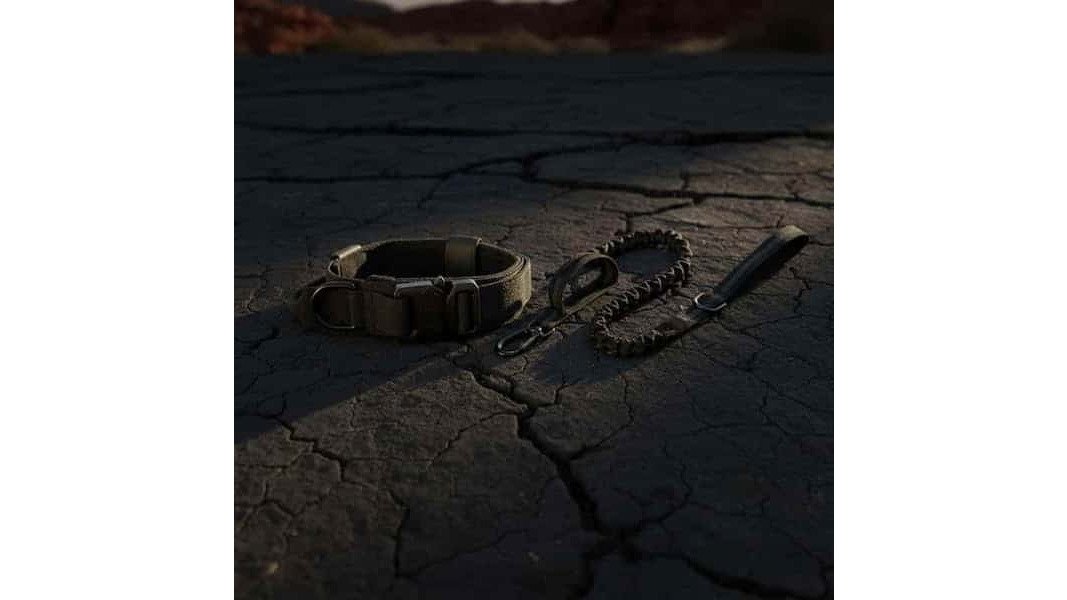
A tactical collar and lead do the jobs a standard set cannot: hold under sudden load, give you a second grab point, and stay visible in low light. The Red Dirt Dogs Tactical Collar & Leash Bundle pairs an aluminium cobra-style buckle collar with a shock-absorbing bungee leash, and the matched set is built to work together rather than fight each other.
Heavy-Duty Tactical Dog Collar →

Choosing the Best Working Dog Equipment for Your Breed
The best working dog equipment is the gear that matches your dog's build, not the biggest or most expensive option. Breed shape decides fit more than weight does, and getting that wrong is the most common reason people give up on tactical gear. Most guides stop at a size chart. The real variable is chest depth and rib shape, because two dogs of the same weight can need completely different strap geometry.
Deep-Chested vs. Barrel-Chested Fitment
A deep-chested dog, think Doberman, Weimaraner, Boxer or a working-line German Shepherd, has a sternum that drops well below the elbow line. On these dogs, a standard girth strap rides forward and saws into the armpit, and the chest plate sits too high on the throat. The fix is to set the chest strap first, drop the chest plate low on the sternum, then take up the slack on the girth strap.
| Dog Type | Neck Range | Recommended Size |
|---|---|---|
| Cattle Dog, Beagle, Border Collie | 35-45 cm | M |
| Kelpie, Pointer, Husky, Dalmatian | 45-55 cm | L |
| German Shepherd, Labrador, Weimaraner | 55-65 cm | XL |
| Great Dane, Mastiff, Saint Bernard | 75-85 cm | XXL |
Sighthound and Greyhound Fitment Notes
Sighthounds need special attention because their heads are narrower than their necks, which makes backing out of a collar easy. A properly fitted collar sits high on the neck behind the ears and snug enough that it cannot slip over the skull. Harness straps need to clear the deep chest without rubbing the shoulder points, and a front-clip design gives you far more control on a dog built for speed.
Why Breed Fitment Beats Brand Loyalty
A common pattern among owners switching from a standard walking harness is buying the same size in a tactical model and finding it does not fit. Tactical harnesses carry more webbing, more hardware and a stiffer chest plate, so the effective fit range is narrower than a soft nylon harness of the same nominal size. Measure your dog fresh, ignore the size on the old harness, and treat the size chart as a starting point rather than a guarantee.
Transitioning From Standard Gear to Tactical Dog Gear
Transitioning from standard gear to tactical gear is a two-week process, not an overnight swap. Dogs notice the weight and stiffness of heavier webbing, so introduce the new collar and harness during low-stakes activities first.
Frequently Asked Questions
What features should I look for in a tactical dog harness?
Prioritise metal hardware over plastic, since aluminium cobra-style buckles and solid D-rings handle load without flexing or rusting. Look for military-grade nylon webbing that resists UV and abrasion, a padded chest plate for pressure distribution, and adjustable straps at the neck and girth. A reinforced control handle gives you instant grip in high-distraction moments, and reflective stitching adds low-light visibility. Escape-proof fit matters most for dogs that back out of standard gear.
How do I choose the right size tactical gear for my dog?
Measure your dog's neck and chest with a soft tape, then add 2 to 3 cm for comfortable movement. Red Dirt Dogs collars run from M (35 to 45 cm) through L (45 to 55 cm) and XL (55 to 65 cm), while the adventure collar covers L (49 to 66 cm), XL (56 to 75 cm) and XXL (75 to 85 cm) for giant breeds. Match the size band to your dog's breed and recheck the fit after the first few wears.
Is a tactical harness or collar suitable for everyday walking?
Yes. Tactical dog gear is built for hard use, so daily walks are well within its limits. The padded interior on Red Dirt Dogs collars keeps them comfortable for all-day wear, and the bungee leash absorbs sudden lunges on ordinary footpath walks just as well as on the trail. The main trade-off is weight and price compared with lighter recreational gear, not suitability for daily use.
What makes Australian-made dog gear more durable for local conditions?
UV-resistant military-grade nylon and rust-proof aluminium hardware hold up to harsh sun, red dust, mud and salt water far better than plastic buckles and untreated webbing. Red Dirt Dogs gear is built with reinforced stitching and weather-resistant materials chosen for Australian conditions. That combination means fewer snapped buckles, less fraying and a longer working life than imported gear that was never tested here.
What are the benefits of using heavy-duty gear for working dogs?
Heavy-duty construction gives you security and control when a dog hits the end of the lead hard. A metal cobra-style buckle will not snap under load, a reinforced handle lets you steady a lunging dog instantly, and pressure distribution across a padded chest plate reduces strain on the neck. For working dogs that pull, track or travel, that reliability is the difference between a controlled day and a bolting dog.