

Best Heavy-Duty Tactical Dog Harnesses for Hiking
Table of Contents
- What Makes a Heavy-Duty Tactical Harness Worth Buying
- Quick Comparison: Tactical Dog Harnesses for the Bush
- How to Measure a Dog for a Tactical Harness
- Tactical Dog Harness Safety Features That Keep Dogs Secure
- Durable Dog Hiking Gear for Rough Australian Terrain
- Weight Distribution and Comfort on Long Treks
- Conclusion
- Frequently Asked Questions
Last Updated: September 15, 2026
What Makes a Heavy-Duty Tactical Harness Worth Buying
Heavy-duty tactical dog harnesses are worth buying when their construction, hardware and fit all hold up under sustained load, not just on a flat suburban footpath. The cheap harnesses that fail are rarely failing because of the strap. They fail at the buckle, the stitching, or the fit.
At Red Dirt Dogs, we build gear for exactly this problem. A harness that survives a season of scrub, rock and creek crossings has four things in common: military-grade nylon webbing rather than flat webbing, heavy-duty stitching at every load-bearing join, metal hardware instead of plastic, and a fit that stays snug when the dog drops its shoulder and pulls backwards.
The other thing worth knowing: a tactical harness is not just a stronger version of a walking harness. It carries load, distributes pressure and gives you a control handle for lifting and scrambling. That changes what you should look for.
Quick Comparison: Tactical Dog Harnesses for the Bush
Here's how the Red Dirt Dogs range lines up for bush hiking, from the everyday workhorse to the sighthound-specific fit.
| Harness | Price | Best For | Key Feature |
|---|---|---|---|
| Anti-Escape Comfort Harness | $59.95 | Dogs that slip out of standard harnesses | 3-layer padded, anti-escape structure, alloy D-ring |
| Hi-Vis Reflective Harness | $49.95 | Low-light and dusk walking | Hi-vis reflective trim, top control handle, quick-release buckles |
| Greyhound and Whippet Harness | $74.95 | Deep-chested sighthounds | 500D Oxford padded panels, greyhound-specific cut |
Pair any of these with a Tactical Bungee Leash - Frog Clip, Dual Handle & Car Seat Buckle at $69.95 for shock absorption on descents, and add the IP67 Tracker Case - AirTag & Smart Tag Dog Collar Holder at $12.95 if you want tracking without a subscription.


For a full picture of what separates a genuinely tough harness from a weekend one, the RSPCA Australia knowledge base on dog harnesses and walking equipment is a useful starting point on fit and welfare.
How to Measure a Dog for a Tactical Harness
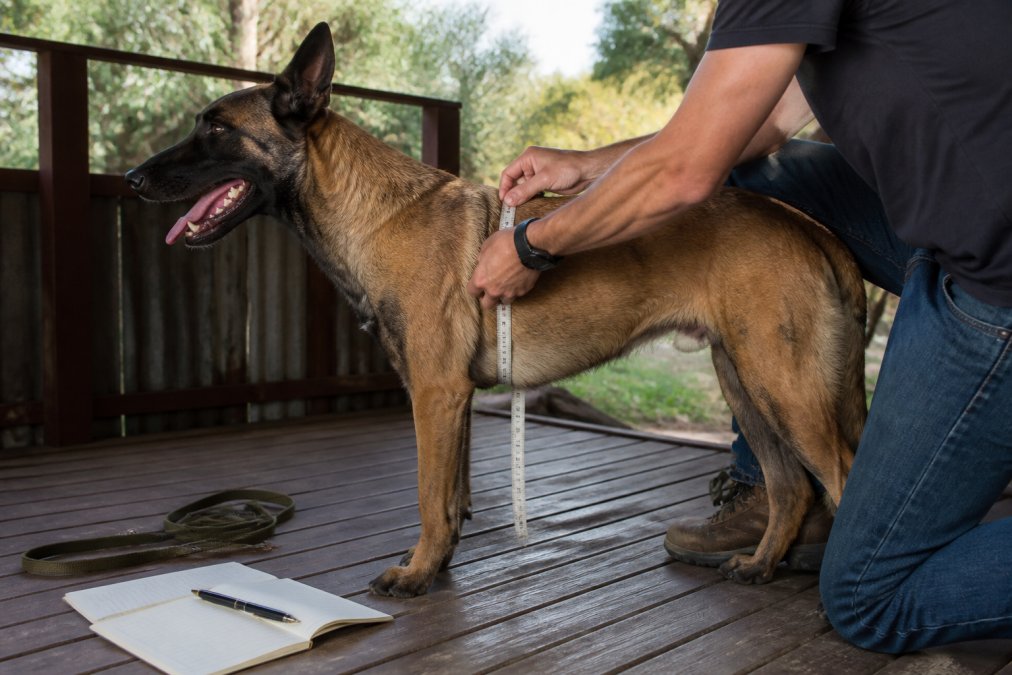
Measuring a dog for a tactical harness requires three numbers: neck circumference, chest circumference just behind the front legs, and back length from the base of the neck to the base of the tail. Use a soft tape measure and allow 2-3 cm of extra room.
The Three Measurements That Matter
Get these three right and you'll avoid the most common sizing failure, which is a harness that fits the chest but slips over the shoulders.
- Neck circumference: wrap the tape around the base of the neck, where the harness sits, not the narrowest point.
- Chest circumference: measure around the widest part of the chest, just behind the front legs, where the load transfers.
- Back length: run the tape from the base of the neck to the base of the tail along the spine.
If your dog falls between two sizes, size up. A slightly generous harness can be adjusted down with the straps; one that's too tight will rub, restrict shoulder movement and cause pressure sores on long treks.
Tactical Dog Harness Safety Features That Keep Dogs Secure
The safety features that matter most on a tactical harness are an anti-escape structure, pressure distribution across the chest rather than the throat, and load-rated metal hardware. Reflective stitching and a control handle are secondary but valuable in the bush.
Anti-Escape Design and Pressure Distribution
An anti-escape design works by keeping the chest strap positioned behind the ribcage and the neck opening snug enough that a dog cannot back out of it. Pressure distribution spreads the pull across the chest plate rather than concentrating it on the trachea, which is what makes a no-pull design genuinely safer rather than just more controlling.
The mechanism is straightforward: a Y-shaped or H-shaped chest plate redirects force from the throat to the sternum and shoulders, while a belly strap stops the harness rotating when the dog lunges. Without that belly strap, a strong dog can twist a harness sideways mid-pull and slip a shoulder, the most common escape pattern we see on working breeds.
Hardware, Load Ratings and Stitching
Look for a solid metal D-ring attachment, quick-release buckles rated for load, and reinforced stitching at the D-ring and handle. As a rule of thumb, a harness intended for a 30 kg dog should have hardware and webbing rated well above that working load, because a lunging dog can momentarily generate several times its body weight in force (What equipment should I use when teaching my dog or puppy to walk on a leash?). Plastic side-release buckles are the single most common failure point on cheap harnesses; alloy or stainless-steel D-rings and welded, not crimped, hardware are what survive a season of scrub.
A reinforced handle is the feature most owners underrate. It lets you lift a dog over a log, hold it steady at a road crossing, or take control in a scramble without grabbing the harness body and risking a strap failure. On a steep descent, that handle is also how you take weight off the dog's shoulders when it's struggling.
Bush-Specific Safety: Snakes, Ticks and Trail Rules
Generic guides stop at fit and hardware. In the bush, three local hazards change what you should look for:
- Snake encounters. A harness with a top handle lets you lift and restrain a dog quickly rather than grabbing a collar it can slip. Keep the dog on a short lead in long grass during warmer months, and know that a harness with a snug chest plate is easier to control than a loose walking harness.
- Ticks and burrs. Padded panels with exposed mesh trap seed heads and paralysis ticks against the skin. Smooth-weave outer fabric and minimal exposed padding are easier to check after every walk.
- National park leash rules. Most state park agencies require dogs to be on a lead no longer than a set length, and some prohibit dogs entirely in conservation zones. A harness with a rated D-ring and a fixed-length lead is the compliant setup; retractable leads are banned in many parks. Check the specific park's rules before you go, because they vary by state and reserve.
A Australian Veterinary Association guidance on canine exercise and heat safety is worth reading before any long trek, because a harness that fits well still needs a dog that isn't overheating.
Durable Dog Hiking Gear for Rough Australian Terrain
Durable dog hiking gear for rough terrain needs abrasion resistance first and weather resistance second, because scrub, rock and sandpaper-dry dirt destroy fabric far faster than rain does.
Weight Distribution and Comfort on Long Treks
Balancing Load in Side Pouches
Heat, Humidity and Breathability
Fit That Holds Over a Full Day
Conclusion
Frequently Asked Questions
What features should I look for in a tactical dog harness for hiking?
Look for reinforced stitching, military-grade nylon webbing and a secure anti-escape structure. A top control handle helps on scrambles, while breathable mesh lining and padded panels reduce rubbing on long treks. Quick-release buckles and a solid metal D-ring matter too. The Red Dirt Dogs Anti-Escape Comfort Harness uses a 3-layer build with alloy hardware and adjustable neck and chest straps, sized S/M/L from $59.95.
How do I ensure a tactical harness fits my dog correctly?
Measure neck circumference at the base of the neck, chest girth at the widest point behind the front legs, and back length from the base of the neck to the tail. Use a soft tape measure and allow 2-3 cm of extra room for comfort. If your dog falls between sizes, size up. The Anti-Escape Harness covers S (40-56 cm chest), M (46-62 cm) and L (58-74 cm).
Are tactical harnesses better than standard harnesses for bushwalking?
For rough terrain, yes. Tactical harnesses typically use heavier webbing, reinforced stitching and metal hardware that resist abrasion from rock and scrub. Many include a control handle for lifting dogs over obstacles, plus MOLLE-style attachment points. Standard walking harnesses often lack that load-bearing capacity and padding, which matters on longer walks where pressure distribution affects comfort.
Can a tactical harness help with dog control on narrow trails?
A harness with a top control handle gives you instant grip when you need to steady or lift your dog over logs, rocks or tight sections. Pairing it with a dual-handle leash, such as the Red Dirt Dogs Tactical Bungee Leash at $69.95, adds a traffic handle for close control and a shock-absorbing section that reduces strain on both dog and handler.
What materials hold up best in harsh bush conditions?
Look for military-grade nylon or high-tenacity webbing, 500D Oxford fabric on padded panels, and aluminium or alloy hardware instead of plastic. Reflective stitching helps in low light. These materials resist abrasion, UV damage and moisture better than lightweight fabrics. The RDD Greyhound and Whippet Harness, for example, uses 500D Oxford padded panels and high-tenacity webbing for deep-chested breeds.